The Room

Some people spend their lives waiting to be let into the room. Others quietly build themselves into someone the room can no longer ignore.
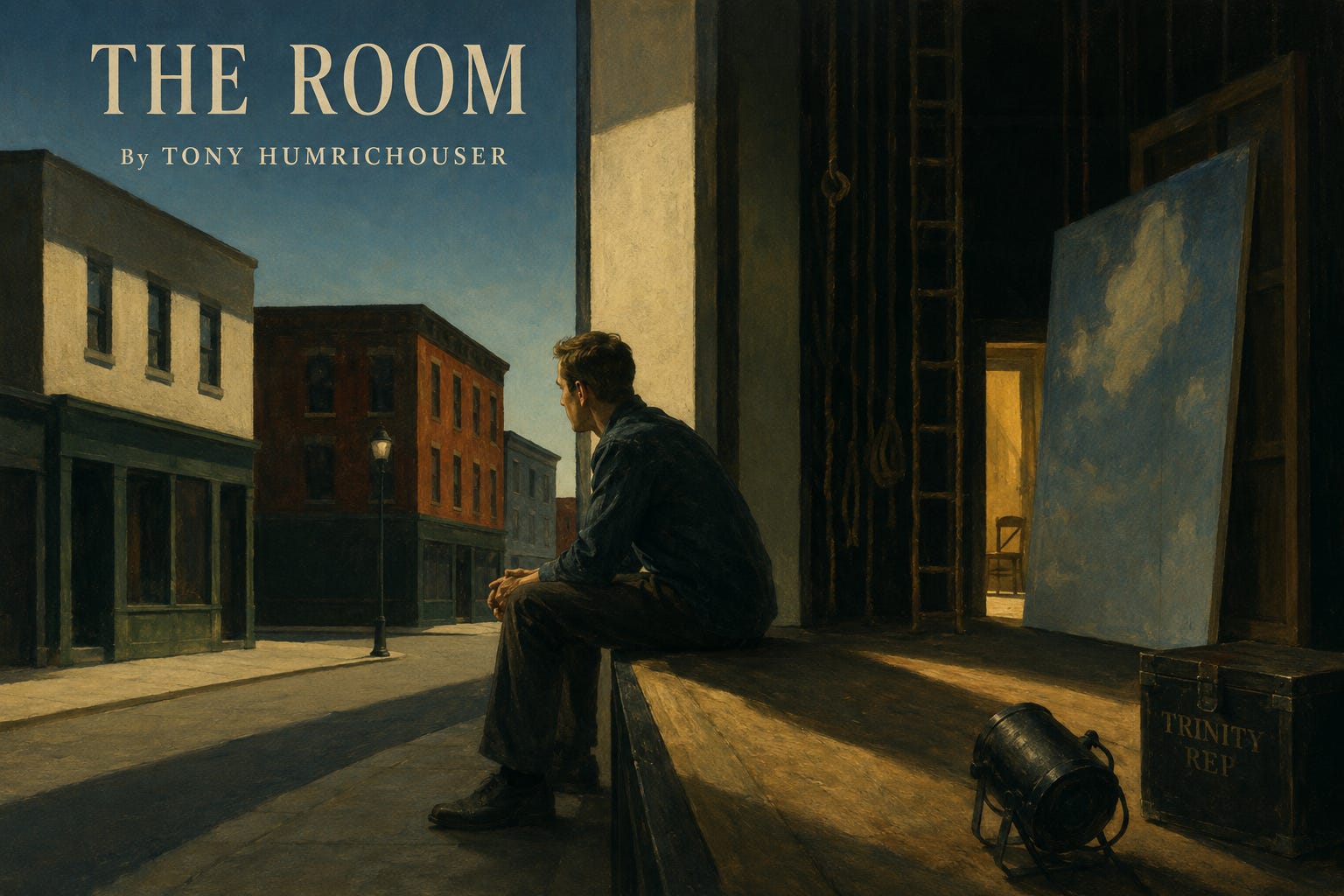
Around this time of year, a lot of young people are graduating from MFA and BFA programs. I hear from some of them, former students and young artists I have worked with over the years, and they make me smile. They are just beginning. They are stepping out into the world, full of hope and nerves and hunger. It is an exciting time.
But one of the things I have learned over a lifetime in the theater is that just because someone has handed you a degree, and that is a tremendous accomplishment, it does not mean the learning stops.
The learning is just beginning.
If you want to take this work seriously, you have to stay sharp. How you keep your tools sharpened is up to you.
My advice is simple.
Find good coaches. Find good teachers. Find people you trust.
And no, you are probably not going to have a lot of money at the beginning. Almost nobody does. So you get creative. You barter. If you are a good actor, find a great singer who needs an acting coach, and let that person play your auditions. Trade what you have for what you need. Meet people. Become each other’s support system. Cook each other dinner. Sit around a table with a plate of pasta and a stack of sheet music and figure it out together.
I have done all of the above.
Be wily.
And remember, as Marianne Williamson once said, “If you are not producing, what is in it for the producer?”
That is not cynicism. That is clarity. You have to bring something into the room. Skill. Preparedness. Generosity. Usefulness. A point of view. A reason for people to trust you with the work.
Find the people who will tell you the truth, stretch you, steady you, and remind you that talent may open a door, but craft is what allows you to stay in the room.
I learned that the way most people do. Through experience, through a fair amount of stubbornness, and eventually by coming out the other side just wise enough to understand that if you want to get better, you have to keep moving.
I was a young actor in Chicago in 1998, looking around at the business I had worked so hard to enter, and realizing that I was still outside certain rooms.
It was not that I was not working. I worked plenty. I was cast in shows around the city, in many of the people’s theaters, the places where Chicago actors learned to work honestly and well. I had a solid lyric baritone tenor voice. It was reliable. I could be counted on. I was also a good character actor, and I had always known that about myself, even when certain people did not quite know what to do with it.
The validation came in other places. It came at the Wagon Wheel Theatre, my lifelong theatrical home, the place I still return to every summer because of its innate authenticity. There, I was not an idea somebody had already dismissed. I was an actor. I was useful in the deepest sense. I belonged to the work.
But in Chicago, I often felt that I was being kept to the side of the picture. I was usually considered for the chorus, the ensemble, the supporting track. I was rarely considered for the role itself.
Even when I did Forever Plaid, there was that same little lesson waiting for me. I was the swing. I would go on, and sometimes I would go on for months at a time. I would live inside the role, carry the show, do the work, and just when I thought, maybe now they will see it, maybe now this will become mine, somebody would return.
And I would be the swing again.
That does something to a young actor. It teaches you how close you can be to the thing you want and still not be allowed to call it yours.
But the wonderful thing, and maybe the saving thing, is that I never stopped studying.
Throughout that entire period, I always took class. I always had a voice teacher. I always kept working. Chicago was full of remarkable artists, and if you were willing to keep learning, there were masters everywhere.
I studied with Becky Menzie, who was, and remains, one of Chicago’s extraordinary vocal coaches. I worked with Vince Lonergan, who was wonderful. Bruce Cain. Music directors like Kevin Cole and Tom Murray, truly gifted musicians who understood not only music, but performers. Directors like Gary Griffin and Ray Frewen. And of course Stuart Ross, who taught all of us something about precision, humanity, and style.
Working with people like that changed me.
These were not casual artists drifting around the edges of Chicago theater. They were serious people doing serious work. Gary Griffin would go on to direct The Color Purple on Broadway and The Apple Tree with Kristin Chenoweth and Marc Kudisch. These were artists operating at a level I could see and feel from inside the room.
And the gift of being near them was that it did not make me feel finished.
It made me want to get better.
Because once you stand in a rehearsal room with artists working at that level, you begin to understand the distance between simply getting through a performance and truly mastering a craft. I realized I wanted to work at their level. I wanted that kind of rigor. That kind of fluency. That kind of artistic confidence.
And I began to understand that if I wanted to live in that world more fully, I was going to have to deepen my education.
So while all of this was happening, while I was swinging and covering and trying to find my footing in Chicago, I was also studying. I was writing papers. I was preparing audition material. I was researching graduate programs. Quietly, privately, I started building a bridge out of the life I was in toward the life I hoped I might still reach.
Because somewhere inside myself, I knew I had more in me than what I was currently being asked to do.
I could have stayed angry. There was enough unfairness to justify it. The business could be arbitrary and dismissive and strangely casual about disappointment. People made decisions in thirty seconds that affected years of your confidence. There were rooms where I felt people had already decided what I was before I ever opened my mouth.
No thanks.
We do not need any of that.
Thanks.
And some actors spend the rest of their lives pointing at those rooms.
But somewhere in the middle of all that frustration, I had a more useful realization. If I was not where I wanted to be, then I had to become stronger than the limitations being placed on me. Not because they were right. They were not. Not because the business was fair. It was not.
But because resentment was not going to deepen my work.
I wanted more than survival. I wanted technique. I wanted language for what I instinctively felt. I wanted to understand acting from the inside out. Voice. Text. Movement. Behavior. Rhythm. Structure. I wanted to know why certain actors could break your heart simply by standing still.
And the painful thing was that I knew how to do that. I had done it many times on stage. I knew how to listen, how to wait, how to let something pass through me without decorating it. But my experience in Chicago had become prohibiting. It did not allow me to show what I had inside.
Then I met two wonderful men, Brian McEleney and Stephen Berenson, at the Trinity Rep Conservatory.
That was a magic time at Trinity Rep. It was run by Oskar Eustis, who would later go on to lead The Public Theater. What an extraordinary lineage to become part of.
Adrian Hall had transformed Trinity from a theater for the people into this majestic, double staged, shape shifting theatrical Xanadu. Actors did not simply walk into rooms there. They rappelled forty feet down from the grid above the audience. They burst through trap rooms beneath false stages. They flew. They vanished. They appeared out of smoke and darkness and thunder.
And presiding over much of that visual magic was Eugene Lee, the legendary resident designer of Trinity Rep, who designed Broadway productions of Sweeney Todd, Show Boat, and Wicked, while simultaneously helping define the visual identity of the theater itself for generations.
It felt less like entering a graduate conservatory and more like being admitted into a living cathedral of theatrical imagination.
So I studied. I wrote papers. I applied.
And eventually, I went to graduate school for acting.
It was one of the best decisions of my life.
And that is the thing I would say to anyone standing at the beginning now, degree in hand, heart full, wondering what comes next.
You never know what awaits you.
This is just the beginning.
Congratulations on your endeavors. Congratulations on the work already done and the work still waiting. Keep your tools sharp. Find your people. Stay curious. Stay humble enough to learn and stubborn enough to keep going.
And if you want it badly enough, and if you keep walking toward it with your whole heart, the world can become just like Oz.
I am not exaggerating.
Thank you for this. I appreciate these words more than ever at this moment.