The Back Row and the Stage
Something I had to leave behind in order to keep becoming myself.

Whenever I am asked - I always respond the exact same way..
The truth is, the Kalamazoo Civic Theatre changed the trajectory of my whole life. I will never really know where I would be sitting without it. I probably would have found my way to the theatre somehow, because that part of me was already there, but to have that kind of experience, that kind of exposure, that kind of immersion in a place where the work mattered so deeply, that was once in a lifetime.
So yes, I am grateful to it on many levels.
Not just to one person.
To the whole thing.
To the building.
To the people.
To the rehearsals, the friendships, the laughter, the nerves, the late nights, the impossible deadlines, the moments when something suddenly worked and everyone in the room felt it at the same time.
I had basically grown up in that theatre as a college student, from 1986 through 1991. Like many before me, and many after me, I found something there that I do not think I could have found in quite the same way at the university.
At Western Michigan University, I was whoever the character was, and that was wonderful. That was training. That was craft. That was technique.
…that was learning how to disappear into someone else.
…but at the Kalamazoo Civic, I became myself.
That was where I got to be the leading man.
That was where I first began to think, maybe I can do this.
And then I did it somewhere else.
And then somewhere else after that.
That is the gift a place like that can give a young person. It does not simply teach you how to perform. It gives you permission. It hands you a little bit of courage and says, go on now. Try. Stand there. Be seen.
Those years were real. They were formative. They gave me a sense of purpose and belonging at a time when I was still discovering who I was and what I could do.
But institutions are complicated things. They are made of people, and people change. Leadership changes. Circumstances change. The energy in a room changes. What once felt like home can, over time, become a place you no longer recognize in the same way.
And sometimes, even when something has meant the world to you, you have to walk away.
That does not mean it was not wonderful.
It means it belonged to a certain season of your life.
The Kalamazoo Civic I knew was a snapshot in time. It was a place, yes, but it was also a collection of people, years, rooms, productions, mistakes, triumphs, laughter, and youth. When you return decades later, you are not really returning to the same place. You are returning to the walls that held the memory.
And that can be beautiful.
It can also be tender.
Because you realize that what you loved still exists, but not in the way you once held it. It exists inside you. It exists in the artist you became. It exists in the way you direct, the way you teach, the way you speak to young actors, the way you understand the sacred, messy, ridiculous, heartbreaking business of making theatre.
My takeaway from those years is still gratitude.
There was a lot of fun.
A lot of laughs.
And in no small way, years of extraordinary work. Performances and productions that would rival any stage in the country.
A lot of people trying, in their own imperfect ways, to make something meaningful.
And then, years later, I found my way back.
The last production my mother saw that I directed was White Christmas.
I had built my way back as a guest director, and I was incredibly proud of that production. More than that, Ma was proud of me. I could feel it. Not in some grand theatrical way, but in the way mothers have of sitting quietly in the back of a room and somehow filling the whole place with their presence.
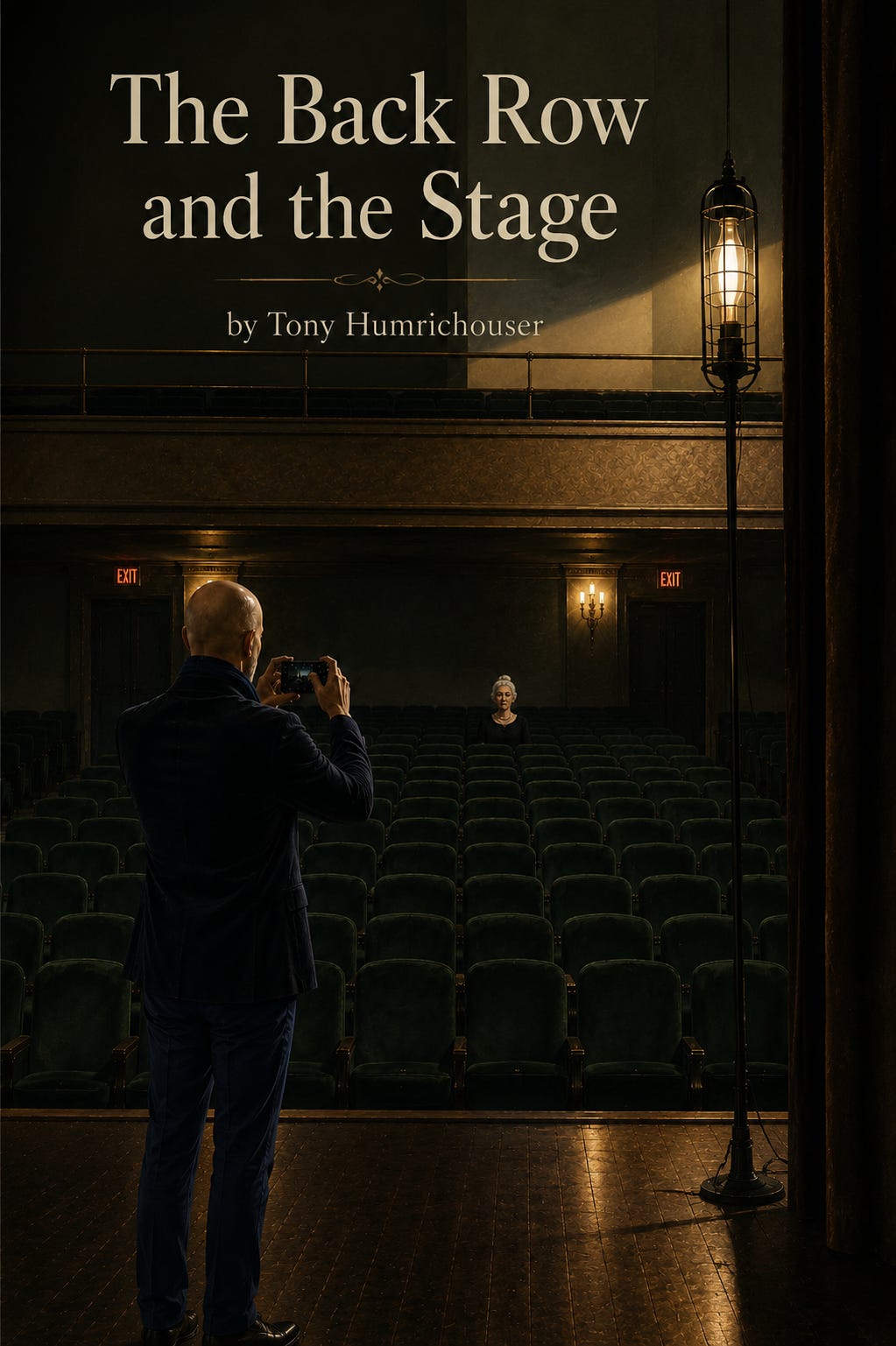
After White Christmas, when the curtain call was over and the audience had begun to thin out, I was sitting in the back of the theatre with Ma. She was wearing her oxygen, and she looked out toward the stage.
Then she turned to me and said, “Tone, I have always wondered what you see from the stage.”
I said, “Do you want to come up on the stage?”
She said, “No, no, no. I want you to go on the stage and take a picture of me in the audience.”
So I did.
I walked onto the stage, turned around, and took a picture of my mother sitting in the very back row, looking at the place where I had stood, where I had worked, where I had once found myself.
I think about that moment often.
Because in some quiet way, it felt like a blessing.
There she was, sitting in the darkened house, looking back at me from the farthest row, seeing what I had seen for so many years. And there I was, standing under the lights, seeing her.
It was not just a photograph.
It was a kind of benediction.
It was Ma saying, without saying it, I see you.
I see what you built.
I see what this place gave you.
I see what you became.
And maybe that is why these old theatres stay with us. Not because they remain the same. They never do. People change. Buildings change. Institutions change. The old rooms get repainted. The voices move on. The ghosts grow quieter.
But once in a while, if you stand in the right place, you can still feel it.
A younger version of yourself waiting in the wings.
A mother in the back row.
A curtain call.
A life beginning.
And maybe that is the kindest way to remember it.
Not as something I lost.
Not as something I have to reclaim.
But as something that helped make me.
And then, when the time came, something I had to leave behind in order to keep becoming myself.
Fin.