Teaching Peace Through the Study of War

Giving peace its due diligence…
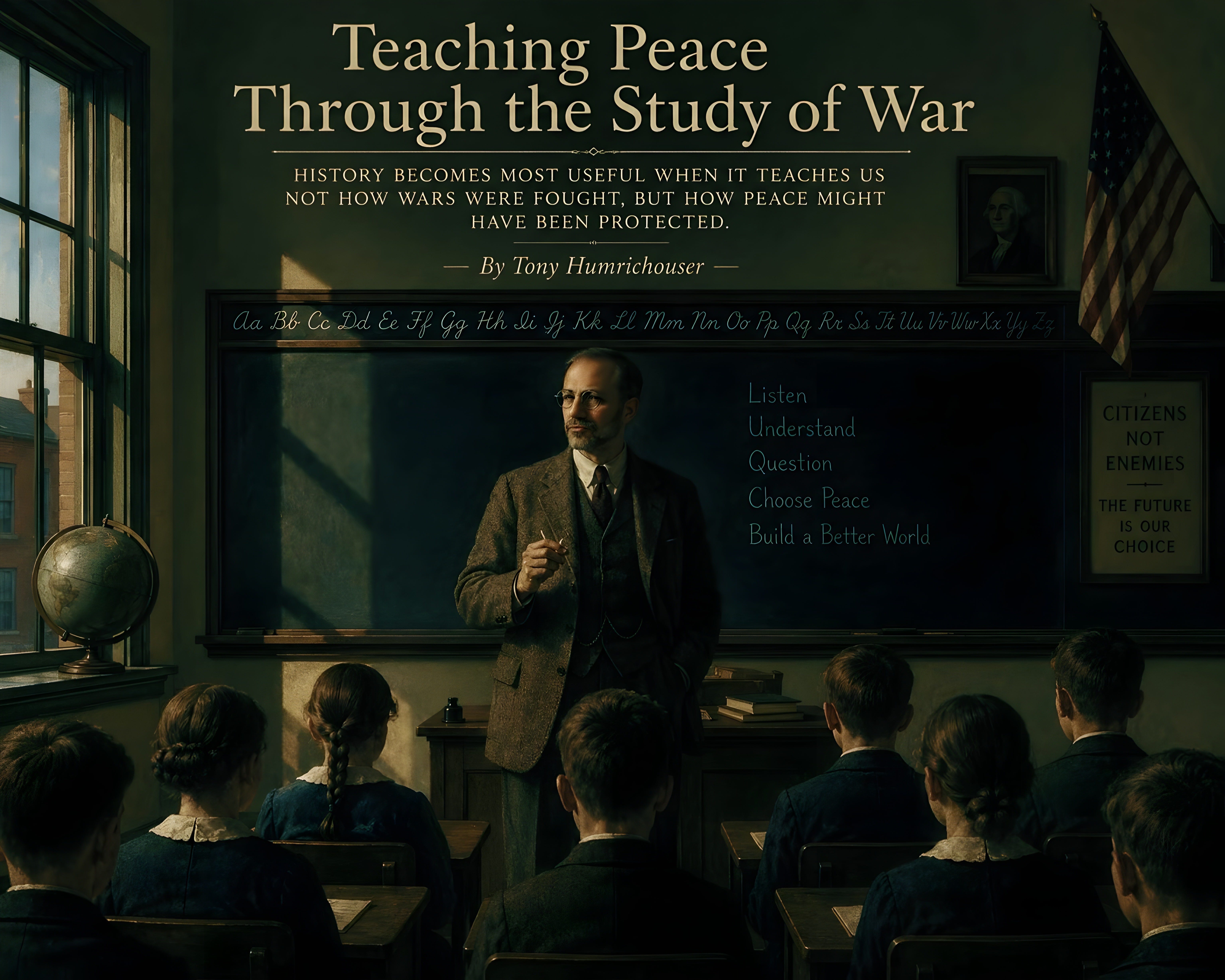
There is something I have been learning more and more while teaching Humanities and History, and it has quietly changed the way I look at the past.
I no longer think the primary purpose of studying war is to learn how wars were fought.
I think the purpose is to learn how peace was lost.
And perhaps more importantly, how it might have been protected.
Most people study World War I, World War II, Korea, and Vietnam as a sequence of dates, battles, presidents, treaties, and endings. One war stops. Another begins. Chapters close. New chapters open.
But history does not really behave that way.
The longer I teach, the more I find myself drawn not simply to what happened, but to what might have happened differently. I keep asking myself where the loose threads were left hanging. What fears were ignored? What wounds were left untreated? Which acts of humiliation, revenge, greed, pride, or exhaustion quietly planted the seeds for the next conflict waiting just over the horizon?
Because so often, the end of a war is not truly an ending at all. It is an intermission.
There are moments after every conflict where nations make choices. Sometimes wise ones. Sometimes frightened ones. Sometimes exhausted compromises that solve the immediate fire while leaving embers glowing underneath the floorboards. And years later, those embers rise again under a different flag, a different slogan, a different generation of young people asked once more to carry rifles into the mud.
But alongside those failures are the moments that deserve just as much attention: the moments when people chose peace instead.
History is also the story of treaties, diplomacy, restraint, mercy, negotiation, reconciliation, and ordinary people deciding that another generation should not have to inherit the same suffering. Those stories matter just as much as the battles.
That is one of the reasons John Lennon’s “Give Peace a Chance” continues to endure. Beneath its simplicity is a deeply human plea. Before the speeches, before the retaliation, before the certainty that violence is inevitable, what if humanity stopped long enough to give peace an honest opportunity?
Peace is not weakness.
Peace is not avoidance.
Peace is difficult.
Peace requires people to stay at the table when they are angry, grieving, frightened, exhausted, or proud. It asks nations to resist the easy escape hatch and remain in the uncomfortable work of truly solving problems instead of merely pausing them.
That may be one of the great unanswered questions at the end of every war: What would have happened if the world had taken all the time necessary to find the best possible solution for everyone involved? Not the fastest solution. Not the politically convenient one. Not the one that allowed everyone to declare victory and move on while resentment quietly grew underground.
The best one.
Because when history rushes past its broken places, those places do not disappear. They wait. They gather force. And eventually, they return.
What has begun fascinating me most, both as a teacher and as a student of history myself, are those fragile crossroads where humanity might have turned slightly left instead of right. Moments where diplomacy could have been stronger. Where mercy may have mattered more than punishment. Where listening may have prevented decades of suffering.
I find that when students begin asking those questions, history changes for them. It stops being memorization and becomes investigation. They begin forming personal relationships with the past. They wrestle with it. Argue with it. Reconsider it. They begin noticing patterns in human behavior that repeat themselves across generations.
And strangely enough, the very act of questioning history often makes it easier to remember.
Facts attached only to a worksheet tend to evaporate. But facts connected to moral inquiry, curiosity, frustration, compassion, or disagreement tend to stay rooted in the mind. Once a student begins asking, “Wait a minute… what if they had handled this differently?” the past suddenly becomes alive.
That may be one of the quiet gifts of Humanities. It allows us to study not only what humanity has done, but what humanity still might become.
Maybe the real purpose of studying war is not to prepare students for conflict, but to prepare them to recognize the value of peace while they still have it.
And perhaps that is the lesson history has been trying to teach us all along.
History becomes most useful when it teaches us not how wars were fought, but how peace might have been protected.