St. Anthony’s Bread
On a hospital hallway, a promised name, and the bread we give because we are here

The tradition of St. Anthony’s Bread begins, at least in the version I love, with a locked door.
A woman in France could not get into her shop. The lock would not turn, and even the locksmith seemed defeated by it. The only solution, he thought, might be to break the door or damage the lock. So the woman did what people have done for centuries when they have reached the end of their own cleverness. She prayed. She asked St. Anthony for help, and she made a promise. If the door opened, she would give bread to the poor.
Then the lock turned.
The door opened.
And she kept her promise.
That is the part of the story I keep coming back to. The miracle did not end with the door opening. It ended with bread in the hands of the hungry. That feels wonderfully Catholic to me, and wonderfully old-world too. A prayer is answered, and then somebody has to be fed. Grace comes through the door, but it is not allowed to sit there looking pretty. It has to become mercy. It has to become bread.
St. Anthony has always been known as the saint of lost things. Most of us learned that little prayer when we were young, the one people say when keys disappear, or glasses vanish, or an important paper seems to have walked away on its own.
“St. Anthony, St. Anthony, please come around. Something is lost and must be found.”
It is almost too simple to call poetry, and yet somehow it is. It tells the truth without dressing it up. Something is lost. Please help me find it.
But as I get older, I think the lost things are not always things. Sometimes what goes missing is patience. Sometimes courage. Sometimes direction. Sometimes the part of ourselves that knew how to trust the morning. Sometimes we lose our tenderness because life has asked us to be practical for too long. Sometimes we misplace joy so quietly that we do not notice it is gone until we hear ourselves laughing and realize how long it has been.
St. Anthony is my namesake, but the story of how I got that name is not ordinary.
I was not supposed to be Anthony.
I was supposed to be John Arthur Humrichouser.
Ma was not supposed to have any more children. Her pregnancy with me was difficult. More than difficult. It was dangerous. She lost weight. She was so sick that my aunt looked at her in the hospital and said, “You are so sick. I wish I could go and have this baby for you.”
Ma was in labor for more than forty hours.
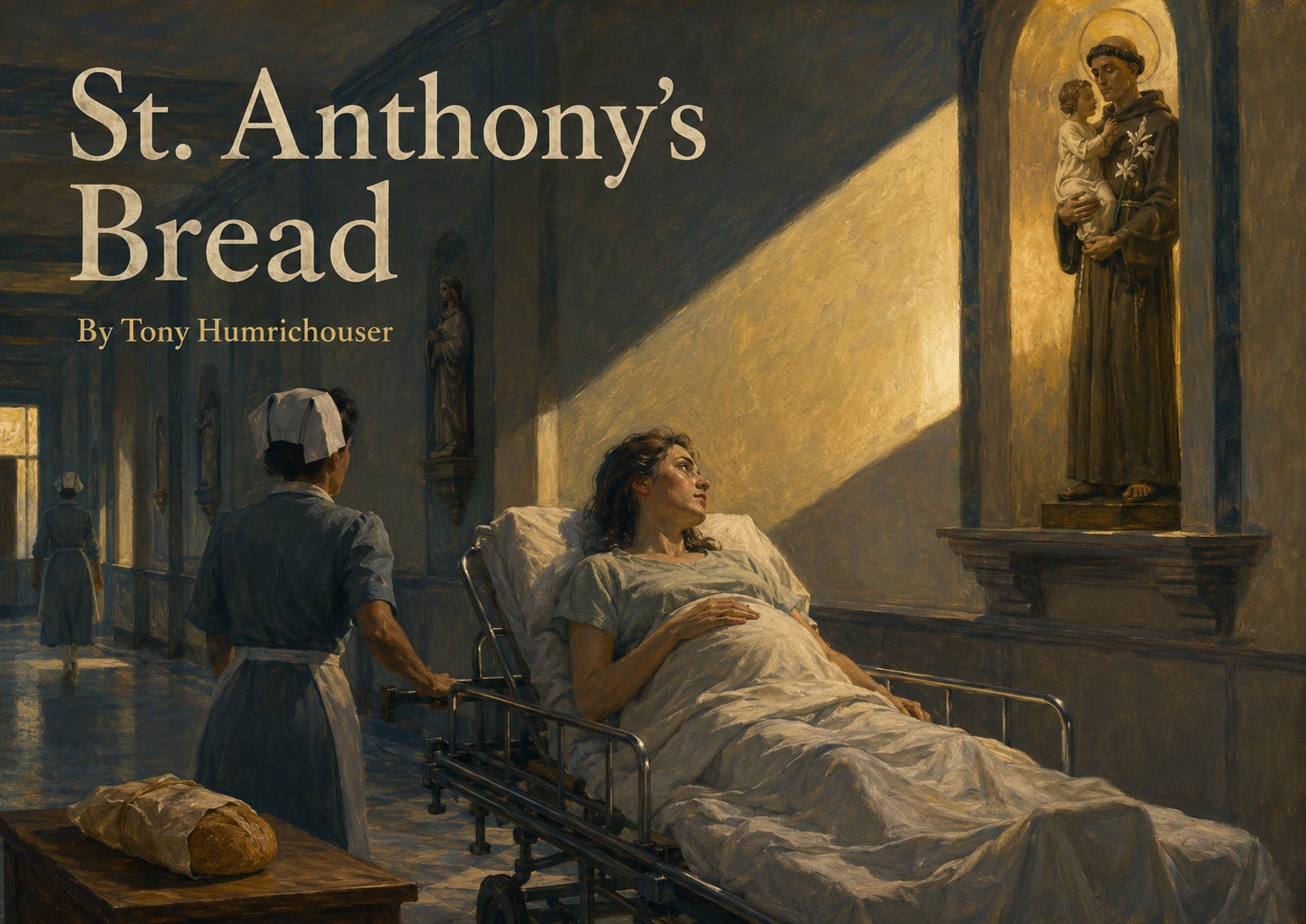
By the time they finally wheeled her down the hallway to deliver me, she was exhausted and frightened and worn down past the point where any person should have to be worn down. And as they moved her through that hospital corridor, she passed statues of saints along the wall.
Now, in Malta, saints are like celebrities. Ma knew them by heart. They were not distant to her. They were familiar. They had names, faces, stories, specialties. You knew who to call on, and when to call.
As she was being wheeled toward delivery, sick and tired and afraid, Ma looked over and saw a statue of St. Anthony.
And she prayed to him.
“St. Anthony, please help me deliver this baby. And if you do, I will name him after you.”
After the delivery, after a day had passed, a nurse asked Ma what she wanted to name the baby.
Ma explained what had happened. She told the nurse, who also happened to be a nun, that she had made a promise to St. Anthony. She had seen his statue in the hallway. She had asked him for help. She had promised that if he helped her deliver this child, she would name the baby after him.
And the nun said, “We don’t have a St. Anthony statue.”
That was how I got my name.
Ma believed it was a visitation.
I grew up with that story, and I do not think you can be given a story like that without carrying it somewhere inside you. A name is one thing when it is chosen from a list. It is another thing when it is born out of fear, prayer, exhaustion, promise, and relief.
I was named not because someone liked the sound of Anthony better than John.
I was named because Ma asked for help.
I was named because she believed help came.
That changes a name.
It makes it feel less like a label and more like a small inheritance.
When I think of St. Anthony holding bread, I think of that hallway. I think of Ma on that gurney, tired beyond words, still reaching toward faith because that was what she had. I think of a woman who had been told she should not have any more children, a woman who was sick and losing weight, a woman who endured more than forty hours of labor and still had the presence of spirit to make a promise.
And then I think of the bread.
The bread is the promise kept after the fear has passed.
The bread is what we give when the door opens.
The bread is what we offer when the child is born.
Maybe that is why St. Anthony has always felt close to ordinary life for me. He is not only the saint of misplaced keys and vanished papers, though I have called on him for those things too. He is the saint who stands near locked doors, near worried mothers, near people who are tired and afraid and have reached the end of what they can do on their own.
He is the saint of finding, yes.
But sometimes he finds us before we know we are lost.
I have spent a good part of my life looking for things. Home. Meaning. Belonging. Vocation. The right room. The right people. The place where my gifts could be used without apology. And like most people, I have also known what it is to feel lost while still appearing perfectly functional. That is one of adulthood’s cruel little tricks. You can carry the groceries, pay the bills, answer the emails, help everyone else find their way, and still wonder quietly where you have gone.
That is why I love the image of St. Anthony holding bread.
The Child Jesus in his arms is beautiful. The lily is beautiful. The book is beautiful. But the bread feels close to the kitchen table. The bread feels like Ma. The bread feels like somebody saying, “Here. Eat something.” It feels like faith with its sleeves rolled up, faith that does not float above the house but walks into the kitchen, checks the cupboard, and asks who has not eaten yet.
Perhaps that is the part of St. Anthony I need most now. Not only the saint who helps us find what is lost, but the saint who reminds us that finding and feeding belong together.
It is not enough for the door to open. It is not enough for the prayer to be answered. Somewhere, somebody is hungry. Somewhere, somebody is waiting for mercy to take a practical form.
And that, too, is what Ma gave me when she gave me his name.
She gave me a story of fear met by faith.
She gave me a story of a promise made in a hospital hallway.
She gave me a name that came not from preference, but from prayer.
And all these years later, I find myself still trying to understand it.
Being named Anthony might mean I am meant to keep looking. To look for what has been lost. To look for what can still be saved. To look for the person in the room who needs kindness before anyone else notices. To look for the door that might still open.
And when it does, to remember the bread.
And maybe that is how I became a baker.
Making bread and giving it to others.
Maybe that is my gratitude for being here in the first place.
What a great story.