Something Made Just for Dreaming

A Memorial Day reflection on Ma, Dad, Aunt Jane, and the small tasks that made a lonely holiday feel like home
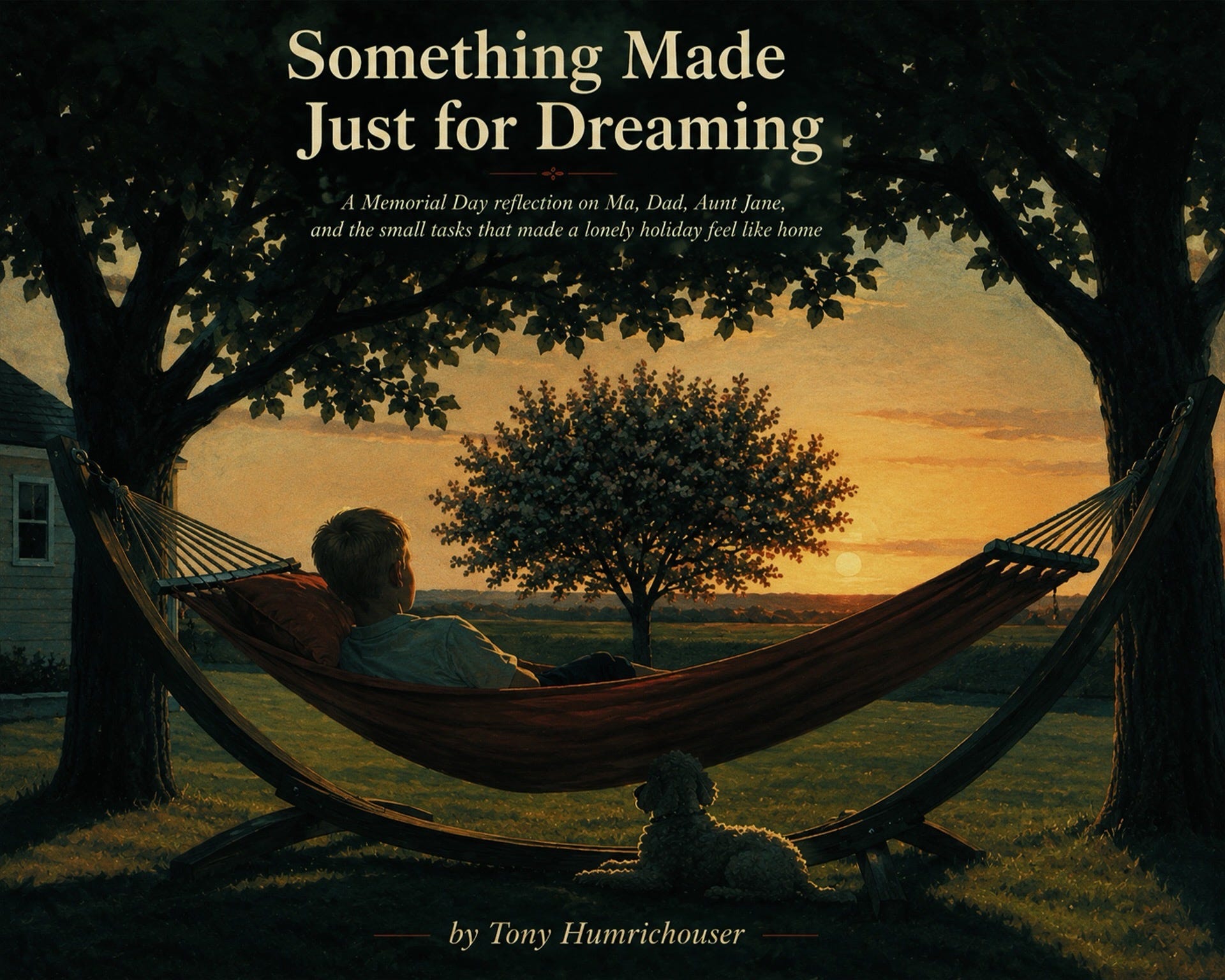
One Memorial Day, my Dad came home with a long cardboard box balanced across his shoulder. On the outside of it was a word that sounded exotic to me then.
Hammock.
Before I quite understood what it even was, he was already outside assembling it in the backyard. My Dad moved that way when he understood something mechanically. There was very little hesitation. Soon there stood a wooden frame holding a beautiful orange canvas hammock with white tassels hanging from the sides and a matching pillow resting at one end like something out of a Sears catalog from a better world.
I thought it was the most beautiful thing I had ever seen.
It was cool outside that day, much like today. One of those strange Memorial Days where summer seems uncertain about arriving. Maybe fifty nine degrees. Mid to upper fifties. The grass still carrying spring in it. The air cool enough that adults occasionally folded their arms across themselves before pretending they were perfectly comfortable.
I remember my Dad climbing into that hammock first and falling asleep almost immediately, the way fathers could in those days. One minute talking. The next minute gone. The hammock swaying gently while somewhere in the distance somebody’s radio played and a lawn mower droned two streets over.
When he woke up, I asked, “Can I take a nap now?”
My parents smiled and said yes.
So I climbed into that hammock, rested my head on that orange pillow, and drifted off to sleep.
Memorial Day weekend has always had a little gray in it for me, even when the sun is shining. It is one of those holidays that promises flags and potato salad and somebody’s cousin arriving with a cooler, but somehow, by late afternoon, it can leave a person standing in the kitchen with the refrigerator humming and the whole world feeling just a little too far away.
This year, as I think about the passing of my Aunt Jane, my memory turns once again toward my Ma and Dad.
My mom and dad were remarkable people.
They could take the dreariest of weekends, Memorial Day, Labor Day, those strange summer holidays with too much expectation and not quite enough company, and turn them into something special. Not with grand plans. Not with speeches. Just with work, food, noise in the next room, and the small mercy of being given something useful to do.
When I was little, my Ma, my aunt, my cousin Charlie, and my sister would sometimes spend an afternoon at the mall or a local department store. I was too small for all that shopping, so I stayed home with my Dad.
It never felt like being left behind for long.
Sometimes he would watch a game on television while I played on the floor with race cars or GI Joes. There might be a sandwich being made in the kitchen, a ballgame muttering from the television, and that particular quiet that settles into a house when the women have gone shopping and the men are not sure they are supposed to do anything except stay alive until they get back.
But often my Dad was building something.
He had an eye for lumber the way some men have an eye for cards or horses. We would be driving down the street when he would suddenly slow the car, stop, back up, and point toward a discarded dresser sitting near the curb.
“Look at that,” he would say. “Solid mahogany.”
Other people saw trash. My Dad saw Sunday afternoon.
Back then my Dad was kind of tough. He could kick a dresser apart with such force and precision that it would suddenly collapse inward, almost like it had been waiting for permission. He knew exactly where the pressure points were. There was a strength in him then that seemed unshakable to me as a child. I did not know that version of my Dad for very long in the grand scheme of things, but when I think back to those years, I remember a man who was strong and not afraid.
He would haul those battered pieces home, break them down, study the wood, and before long he had a plan. Within weeks, somebody had a table or a chest that looked as though it had always belonged in a family.
And beside him stood me.
He gave me my first toolbox when I was very small. Not toy tools. Real ones. A hammer with the handle broken down to fit my hand, taped at the end so I could grip it. A screwdriver. A tape measure. A flat carpenter’s pencil. A few nails. A few screws. Even a little manual drill.
I loved that toolbox with all my heart.
At first I watched him. Then I used the scraps. Then he encouraged me to try what he was doing. There were no speeches about craftsmanship, no lesson plans, no laminated objectives. Just a man, a boy, a piece of wood, and the understanding that if you ruined one scrap, there was usually another nearby.
My Ma taught the same lessons inside the house.
If she was on the phone with one of her sisters or trying to watch one of her soap operas and I was underfoot, she did not banish me. She gave me purpose.
My favorite task was, “Go fix the cans.”
That meant going into the pantry and organizing every can so the labels faced out neatly, like a little grocery store run by a very short manager with serious opinions about peas.
I was so proud when she checked my work and told me I had done a good job.
Or she would hand me the small horsehair brushes she kept in a wooden cylinder and say, “Go dust the dressers and the television.”
The furniture back then had all that ornate Mediterranean googly gook on it, the kind of carved swirls and flourishes that seemed designed by somebody who had never once considered dust. Every groove held onto it. Every curve had a secret. And there I would be, serious as a museum curator, brushing every crevice clean while her stories played in the background and the house went on breathing around me.
And in the kitchen, both my Ma and Dad believed children belonged near the work.
They handed us potatoes to peel, carrots to cut, beans to snap, garlic to skin and slice thin. We sat at the table and learned by doing. Nobody announced that we were learning life skills. Nobody called it enrichment. They just moved over and made room.
That was their genius.
They made children feel useful.
Not entertained. Not managed. Not praised for breathing. Useful. Included. Trusted.
And that is no small thing.
A useful child learns that he has hands for a reason. He learns that he can make order from a pantry shelf, beauty from a scrap of mahogany, dinner from a potato and a bowl of beans. He learns that family is not only something you belong to. It is something you help keep.
Looking back now, especially on a holiday weekend like this one, I realize those afternoons were never ordinary at all. They were the architecture of a family. Tiny domestic rituals holding up the roof.
A baseball game on television. A pantry shelf lined up neatly. Sawdust in the garage. Garlic skins on the kitchen table. A soap opera murmuring from the living room. A child carrying a tiny toolbox or a horsehair brush, believing with all his heart that what he was doing mattered.
And because of them, it did.
And then, later that same Memorial Day weekend, I woke up in that orange hammock.
The sun had finally come out.
The hammock was strung between the canopy of our pear tree and our cherry tree, tucked there in the soft green shade like something made just for dreaming. Across the way stood our Italian plum tree, and through its branches came the most beautiful golden Michigan sunset, warm enough that it almost seemed to carry us all the way back to Malta.
My Ma and Dad had placed a wool blanket over me while I slept so I would stay warm and comfortable in the cool spring air.
And beneath the hammock, faithfully lying underneath me like a guardian, was our dog Fuji.
All on Memorial Day.
And somehow, when I think of home, I still return there first.