Guardrails

The most important guardrail is the small voice that says, “This is mine to make.”
We have been hearing a great deal about guardrails lately.
Everywhere you turn someone is talking about the guardrails on artificial intelligence. Some people think there are too many. Some think there are not enough. The word itself has become a kind of modern political football, tossed around by people who often seem less interested in safety than in speed.
Like everyone else, I have been experimenting with these tools. I started with ChatGPT. Then Claude. Then every educator’s platform that now promises some version of “AI assistance.” Even the writing software I have loved for years has joined the parade. It now cheerfully informs me that artificial intelligence is ready to help.
You cannot get away from it.
And I will confess something that feels slightly old fashioned to say out loud. A small part of me wishes the whole thing could be replaced with paper.
Not fancy paper. Just a plain sheet of parchment and a sharpened pencil.
It would be a Number Two Ticonderoga, of course. That has been my pencil since childhood. The yellow paint, the pink eraser, the little green band that holds it together. There is something honest about a pencil. You write a thought. If the thought is wrong, you erase it and try again.
Even Leo Bloom knew the value of a good pencil. When he leaves the office in The Producers, he carefully returns the Ticonderogas to their cup, as if restoring order to the universe before he steps out into the chaos of Broadway. I have always admired that moment. It suggests a man who understands that small acts of responsibility matter.
Which brings me back to guardrails.
People are arguing about guardrails in artificial intelligence, but the truth is the place we most desperately need them is not in machines. It is in ourselves.
Somewhere along the way we seem to have lost our social guardrails.
Once upon a time there were certain invisible agreements that kept society moving in a reasonably straight line. Not perfect, certainly. Human beings have never been perfect travelers. But there were lines we did not cross, or at least we understood that crossing them had consequences.
Now it sometimes feels as though we are all passengers on a perfectly good train, rolling along through a landscape that took generations to build. The tracks are steady. The direction is clear.
And suddenly someone dressed like a clown wanders into the switching station.
He pulls a lever.
Without warning the train lurches sideways and we are no longer on the main line at all. We are on some wild amusement park track, twisting and rattling through turns nobody asked for. The mine ride at Cedar Point comes to mind. The kind where the cars bang and clatter and everyone grips the sides wondering how we got here.
That is what the modern world sometimes feels like.
The internet opened the door to that ride. Artificial intelligence may simply accelerate it. Neither technology is evil by itself. A railroad track is not evil either. The question is always the same one.
Who is driving the train?
Now my personal issue with artificial intelligence is something a little simpler.
AI does not know me.
As intelligent as it may appear, it cannot possibly know me. It does not know where I grew up, what songs were playing in the kitchen when I was a boy, or the exact sound a Number Two pencil makes when it rolls across a wooden desk. It does not know the small memories that shape the rhythm of a person’s writing.
And the truth is I enjoy writing.
I do not need the assistance.
Writing, for me, is not a task to be optimized. It is a process of discovery. Sometimes you sit with a sentence for twenty minutes. Sometimes a paragraph refuses to behave for an hour. But somewhere inside that struggle is the voice that belongs only to you.
But here is something else about me.
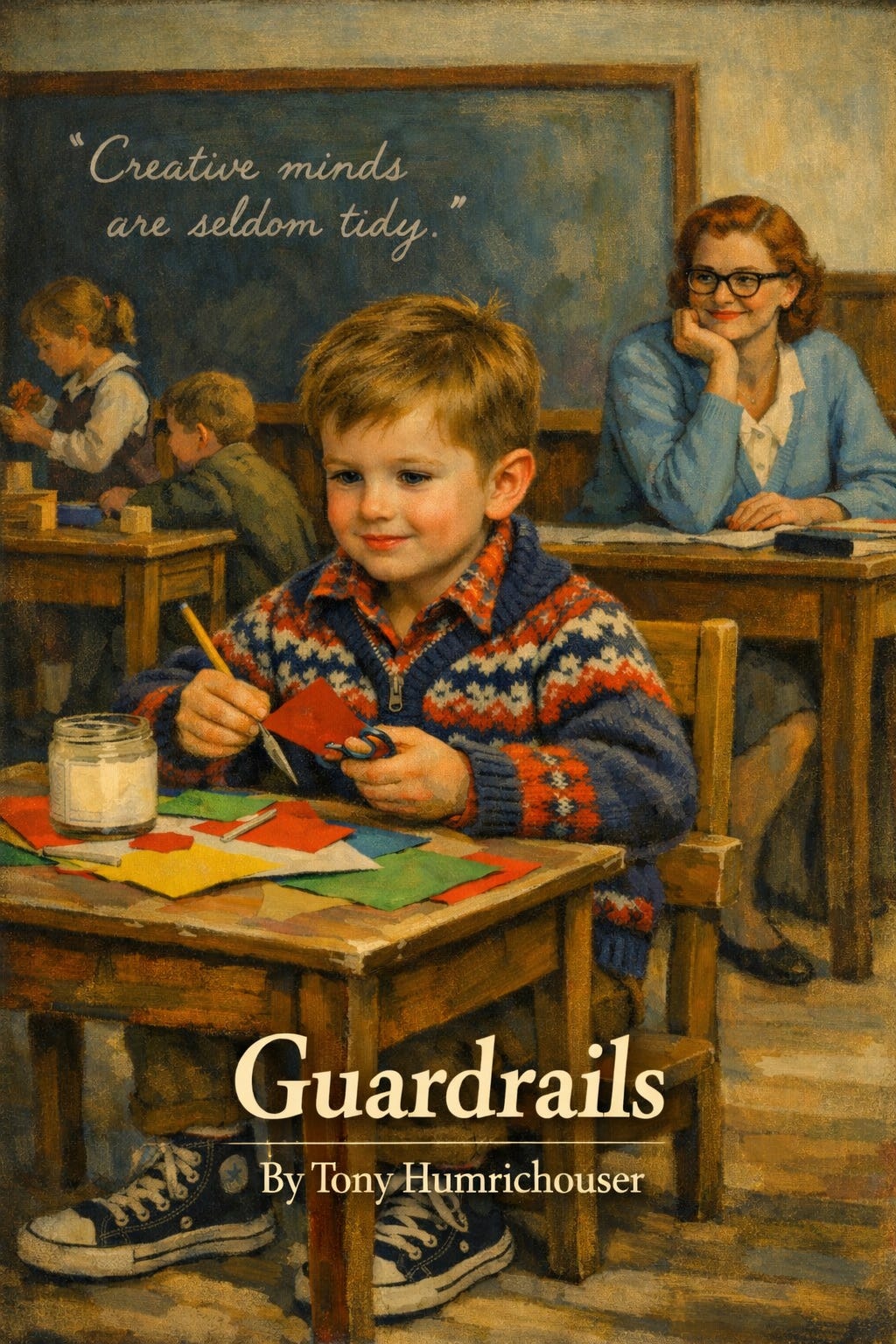
When it comes to creativity, I am essentially a spoiled kindergartner.
No one is ever going to tell me how to make something. No artificial intelligence is going to bully me out of my paste, my paper, my scissors, or my supplies. I am very protective of them.
Not greedy. Protective.
In fact, one of my kindergarten teachers wrote something on my report card that I have never forgotten.
“Uses scraps effectively.”
Which is about the nicest thing you can say about a creative person. It means you can work with very little and still make something out of it.
But do not tell me how to work with it.
That part is mine.
Every kindergartner understands this instinctively. Give them paper and glue and markers and they will go to work immediately. And heaven help the adult who walks over and says, “Maybe you should do it this way.”
The reaction is immediate.
No.
This is my creation. I know what it is supposed to be. I know what it needs. And you are not making it better.
I work with children every day, and I see it constantly. They will defend their artwork with the ferocity of a museum curator guarding the Mona Lisa.
Which, if you think about it, is a marvelous instinct.
Imagine what the art world might look like if we unleashed a room full of kindergartners in the galleries. No polite nodding. No careful whispering about theory and influence.
Just honest reactions.
“That painting needs more purple.”
“That sculpture looks like a sandwich.”
“That one is beautiful.”
Creativity, at its heart, belongs to that same stubborn impulse. The quiet insistence that something inside you has the right to exist in the world exactly the way you made it.
Artificial intelligence can generate things. It can assist. It can imitate.
But the impulse to create something that belongs entirely to you.
That still belongs to the kindergartner.
And perhaps that is the guardrail we should be protecting most of all.