Care Before Crisis
What Susan Sheehan’s Is There No Place on Earth for Me? made me imagine, and what the world keeps refusing to build.

Susan Sheehan’s Is There No Place on Earth for Me? stayed with me, not only because of its sorrow, but because of what it made me imagine, and because of what it forced me to remember.
We talk about protecting children a great deal in this country. We always have. We make speeches about them. We build campaigns around them. We invoke them whenever we want to sound moral, decent, and upright. And yet if you look at the news for any length of time, you begin to see the truth underneath the performance. “The system” fails children over and over again. It fails them in schools. It fails them in homes. It fails them in hospitals, agencies, courts, and communities.
We have become very good at saying children matter…
We are far less reliable when it comes to building a world that proves it.
That is part of what this book stirred in me.
Not only grief. Not only pity. Longing, yes, but also anger. Because it should not be this hard for a child to be seen. It should not be this hard for a family to be heard. It should not require a breaking point before anyone decides suffering is real.
What if children struggling with their mental health were met early, gently, and without shame? What if families did not have to fight so hard to be heard? What if schools, doctors, counselors, and communities worked together with the same urgency we bring to a child with a fever or a broken arm? What if care came before crisis?
That is the world I found myself longing for as I read.
A world where mental health care is woven into ordinary life. A world where somebody notices the quiet signs. The child who has stopped laughing. The child who cannot settle. The child who grows too silent. The child who acts out because pain has nowhere else to go. The child who works so hard to appear fine that the effort itself becomes a kind of sorrow. A world where someone listens closely and steps in before the breaking point.
Being an advocate for children matters deeply to me. So does understanding how the system really works, because it is not enough to love children in theory if you do not know what stands in their way. And what stands in their way, all too often, is not mystery. It is bureaucracy. It is delay. It is indifference dressed up as procedure. It is a culture that waits too long, documents too much, deflects too often, and intervenes only when the damage has become impossible to ignore.
Too many parents are asked to become fighters when they should have been allowed to remain simply parents. They learn the language of reports and meetings and hearings. They learn how to document, appeal, insist, and press. They learn that tenderness alone does not move the machine. Sometimes the machine has to be pushed. Sometimes challenged. Sometimes cornered. Sometimes forced to do what it was supposed to do from the beginning.
And that, to me, is part of the heartbreak.
Not that pain exists, because pain has always existed. It is that pain is so often left alone too long. It is hidden for the comfort of others. It is explained away, minimized, shamed, or turned into something private that must be managed quietly so no one else has to feel disturbed by it. And children, who should never have to become experts in concealment, learn very early how to carry what hurts in silence.
Hope begins, I think, in refusing that silence.
Not in pretending pain does not exist. Not in wrapping everything in slogans and calling it awareness. Not in admiring our own compassion from a safe distance. Hope begins when care meets pain sooner. When we decide that no child should have to prove they are suffering enough to deserve tenderness. When we stop treating the mind as some lesser, awkward, embarrassing part of the body and start treating it with the same seriousness, urgency, and mercy.
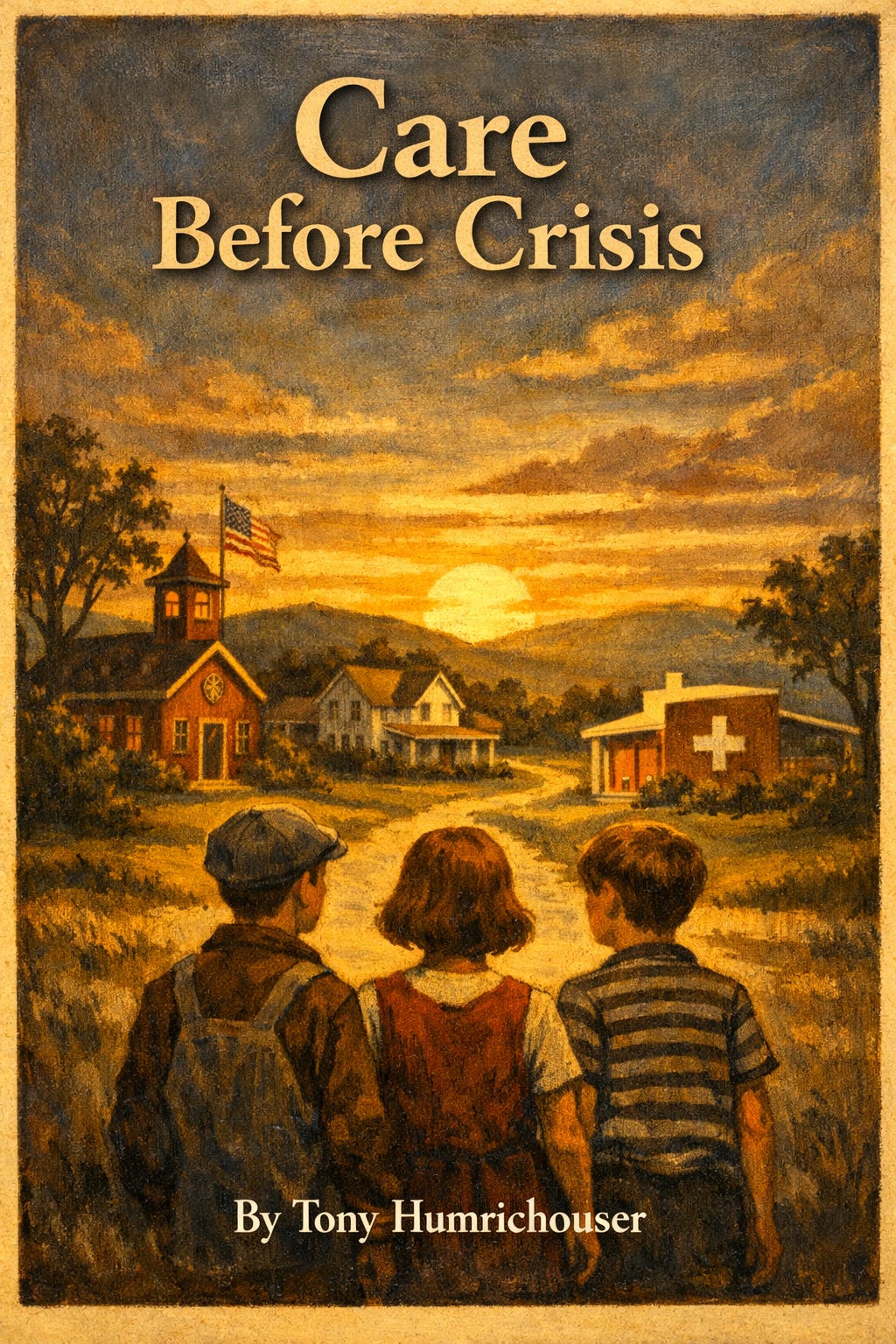
There is an image that has stayed with me alongside the book.
Children are not running. They are not bracing. They are simply looking ahead. A school, a home, and a place of healing share the same landscape.
Not hidden.
Not banished.
Not spoken of in hushed and embarrassed tones.
Simply there, as natural as the road, the trees, and the evening light.
That is the dream underneath all of this.
Not a perfect world. I do not believe in perfect worlds. But a more attentive one. A more honest one. A kinder one. A world where children grow up knowing their minds matter as much as their bodies, and where the adults around them are willing to build something that acts like it knows that too.
Because healing does not always arrive with great noise. Sometimes it comes quietly. In the steady presence of another person. In the teacher who notices. In the counselor who listens. In the parent who refuses to look away. In the community that decides a child’s suffering is not an inconvenience, not an embarrassment, not a private family burden, but a call.
Susan Sheehan gave us a portrait of what happens when care comes too late, when suffering is mishandled, postponed, institutionalized, and misunderstood. What stayed with me after reading her was not simply sadness. It was the unbearable recognition that so much of this still feels familiar. Different language perhaps. Different buildings. Different policies. But too often the same failure to meet pain before it becomes catastrophe.
That is why this matters.
Because children should not have to break open before adults decide to care.