Begin Again
At Easter, even actors are called back to the beginning

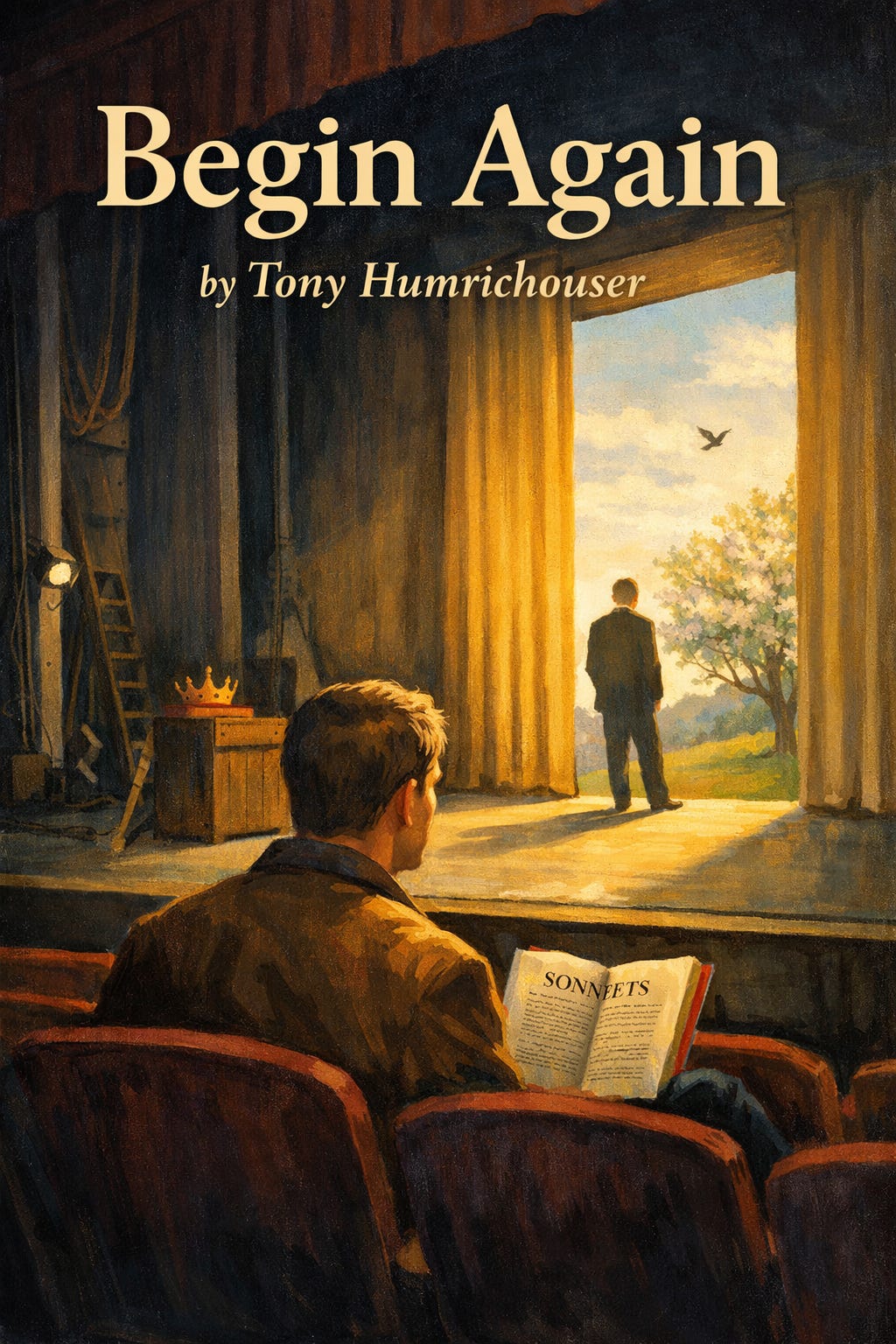
It is a beautiful Good Friday. Of course, it is cloudy. It is a little chilly. But it feels like spring.
The trees are budding. And there is one tree that usually flowers right around Easter time. That is my hope this year. That on Easter Sunday we will wake up to blossoms on that tree. Gosh, renewal and beginning, it always feels exciting.
At Easter, I always think there is something deeply right about returning to the beginning.
The season itself asks it of us. It asks us to look again at what we believe, what we serve, and what we are willing to give ourselves back to with a full heart. Things that seemed buried begin to stir. What looked dormant was only waiting. The world itself offers a quiet sermon in renewal.
And for actors, that feeling ought to make perfect sense.
We can get so caught up in the machinery of the profession.
Auditions.
Rehearsals.
Bookings.
Concepts.
Cuts.
Notes.
Timing.
Reviews.
Survival.
All of it matters, of course. But every so often, a season arrives that asks something gentler and more profound of us. It asks us to begin again. It asks us to return to the source. It asks us to recommit.
Oscar Hammerstein, that wise and generous soul of the American theater, told us plainly, “Let’s start at the very beginning.” He was right about more than music. He was right about the work itself.
Because the arrogance of the performer can sometimes whisper otherwise. It can say, why should I have to go back to the beginning? I have arrived. I have experience. I know how to do this. But what that kind of confidence forgets is that experience is built on small lessons.
It is built on first things.
It is built on the repeated shaping of craft, one choice, one breath, one vowel, one thought, one turn at a time.
And it is good to return to those smaller lessons. In fact, it is necessary.
Those early lessons are not childish things to be cast aside once you have a résumé and a few curtain calls behind you.
They are the fine tuning of technique.
They are the hidden calibrations.
They are the little adjustments that keep the instrument honest.
Technique, if it is truly alive, should be worked on so faithfully and so often that it begins to seem transparent. It should not call attention to itself. It should serve the thought, the feeling, the story. It should become clear glass.
Too often, though, people skip those steps. It is as if we want to operate the machinery without reading the instruction manual. We want the result. We want the performance. We want the output. But we forget that the machinery itself contains a thousand small possibilities, and unless we return to the manual, unless we go back to the setup, we forget what the instrument can actually do. We forget its range. We forget its precision. We forget the small settings that make the whole thing work beautifully.
That is why I think every actor is well served by going back to the sonnets.
Before the full sweep of the plays, before the crowns and swords and fools and storms, there is the language itself.
There is breath.
There is thought.
There is ache.
There is argument.
There is wit.
There is longing.
There is the turn of the human heart caught in speech.
The sonnets are not a side road. They are the foundation. They are where Shakespeare teaches us how a thought is born, how it shifts, how it contradicts itself, how it breaks open, and how it rises.
How can an actor hope to perform an entire Shakespeare play without having first worked on the sonnets?
That is not a scolding question. It is an honest one. The sonnets are the workshop. They teach us how to speak the line and how to live inside it. They ask us to persuade, confess, yearn, grieve, remember, envy, delight, and discover. They teach us how Shakespeare makes music out of thought. They teach us how language moves when it is tethered to real feeling.
And that feels especially right at Easter.
Because Easter is, among many things, a call to renewal. A call to remember what we believe in. A call to return to first things. A call to come back with intention, humility, and love. In the life of an actor, that can mean returning not simply to performance, but to practice. Not simply to ambition, but to truth. Not simply to being seen, but to seeing more clearly what the work asks of us.
So if there is an Easter lesson here for actors, I think it may be this. Go back to the well. Recommit to the language. Return to the beginning. Let yourself be restored by the very thing that made you want to do this in the first place.
And perhaps no sonnet says that more beautifully than Sonnet 29.
It begins in despair. The speaker feels abandoned by fortune, ashamed before the world, isolated, envious, and cut off from grace. But then, in the middle of all that sorrow, something changes. He remembers love. And in remembering love, he rises. His whole inner life is transformed. What begins in self reproach ends in abundance. What begins in isolation ends in song. That movement from heaviness to hope, from earth to heaven, feels to me like an Easter lesson if ever there was one.
Here is the sonnet in full:
Sonnet 29
William Shakespeare
When, in disgrace with fortune and men’s eyes,
I all alone beweep my outcast state,
And trouble deaf heaven with my bootless cries,
And look upon myself and curse my fate,
Wishing me like to one more rich in hope,
Featured like him, like him with friends possessed,
Desiring this man’s art and that man’s scope,
With what I most enjoy contented least.
Yet in these thoughts myself almost despising,
Haply I think on thee, and then my state,
Like to the lark at break of day arising
From sullen earth, sings hymns at heaven’s gate.
For thy sweet love remembered such wealth brings
That then I scorn to change my state with kings.
That is the lesson.
Not that despair never comes. It does.
Not that actors will never doubt themselves. We will.
Not that the world will always reward devotion or talent or discipline. It will not.
But remembrance can raise us. Love can restore us. The thing we thought was lost can be found again. And what seemed buried may only have been waiting for the right season to rise.
That is true of faith. That is true of spring. And I suspect it is true of acting too.
At Easter, I think we are invited to begin again.
And for an actor, that may mean opening the sonnets, taking a breath, and remembering that before there was performance, there was the word. Before there was applause, there was the thought. Before there was ambition, there was love.
And that is where it is good to start.
The Easter Lesson in Plain Speech
And because Easter is also a season of learning again what we thought we already knew, I think it is worth walking through the sonnet slowly, plainly, and line by line.
When, in disgrace with fortune and men’s eyes,
This means that life feels turned against me, and other people do not think much of me either. Luck is gone. Approval is gone. I feel low in my own eyes and in the eyes of the world.
I all alone beweep my outcast state,
I sit by myself and feel sorry for my condition. I feel left out, pushed aside, almost as though I do not belong anywhere.
And trouble deaf heaven with my bootless cries,
I pray and complain and call upward, but it feels like nobody is listening. Heaven seems deaf. My cries feel useless.
And look upon myself and curse my fate,
I look at my own life and think, why did this happen to me? I blame my circumstances. I feel bitter about where I have landed.
Wishing me like to one more rich in hope,
I wish I were more like somebody else, somebody who seems naturally hopeful, somebody who wakes up believing good things are coming.
Featured like him, like him with friends possessed,
I wish I looked like another man, and I wish I had his friends too. It is envy, plain and simple. I want his face, his ease, his company.
Desiring this man’s art and that man’s scope,
I want one fellow’s talent and another fellow’s opportunities. I look around and think everybody else got a better basket of gifts than I did.
With what I most enjoy contented least.
Even the things I usually love no longer satisfy me. That is how deep the mood has gotten. The world has gone gray.
Yet in these thoughts myself almost despising,
I have fallen so far into self pity that I am nearly disgusted with myself. I do not just feel bad. I feel bad about feeling bad.
Haply I think on thee, and then my state,
Then by chance, or maybe by grace, I think of you. And the moment I do, my whole condition begins to change.
Like to the lark at break of day arising
It is like a bird lifting up at sunrise. A lark rises from the ground into the morning air. The image is light, motion, and release.
From sullen earth, sings hymns at heaven’s gate.
Up from the heavy, gloomy earth, the bird sings as though it were right near heaven itself. He goes from mud to music. That is the turn in the sonnet.
For thy sweet love remembered such wealth brings
Just remembering your love makes me feel rich. Not money rich. Soul rich. Heart rich. The kind of rich that steadies a man.
That then I scorn to change my state with kings.
And once I remember that love, I would not trade places with anybody, not even a king. A king may have power, but he does not necessarily have what matters most.
So friends…Happy Easter. Go back…go back to the beginning, because what first taught you how to do the work may also be what saves and renews it.