Are You Coming?
Another story from our friends in Chicken, Alaska

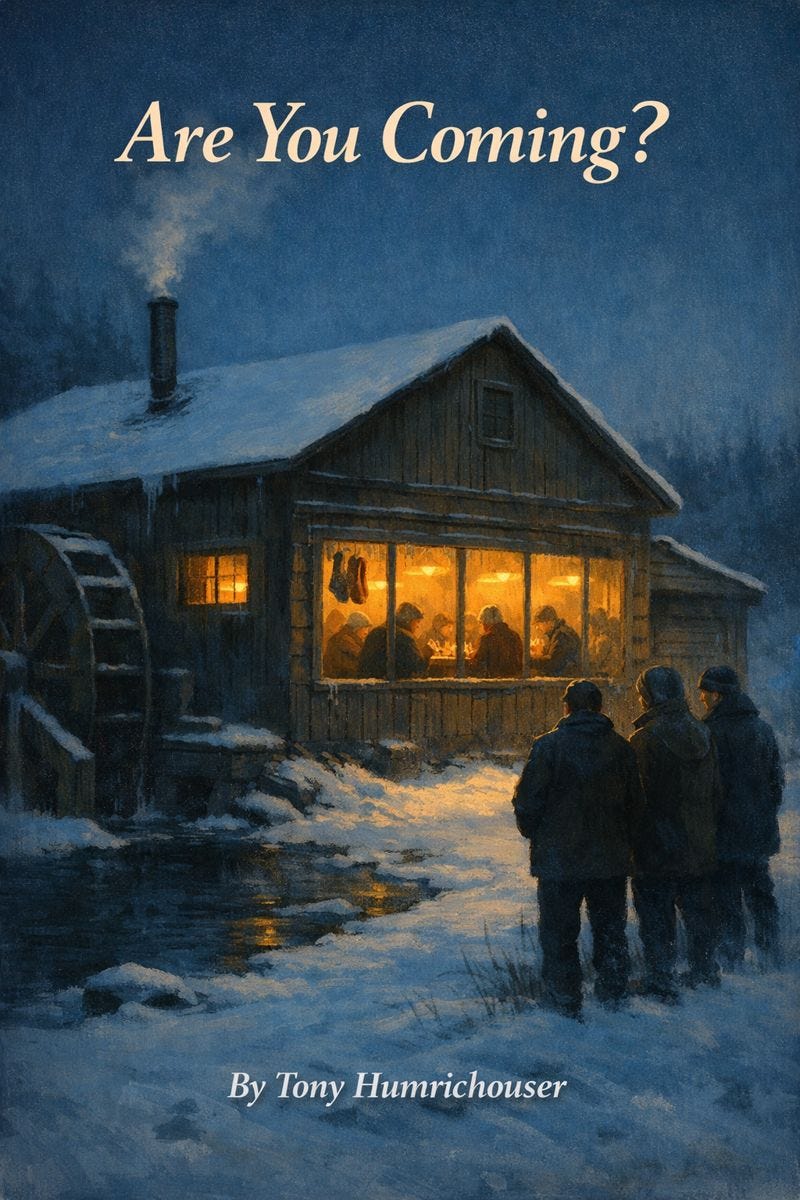
In Chicken, Alaska, January has a way of making the moral life feel practical. The cold is not theoretical. Neither is hunger. Neither is loneliness. You learn quickly who you can count on, who keeps the stove going, and who pretends not to see you when you step into a room. January is a lonely month for many folks, and it has a way of watching generosity slip quietly back out the window. The casseroles are gone and the borrowed cheer has been returned to its box.
The phone rings less often during these months, and when it does, it is usually about something practical or overdue. The lights come down, the music stops insisting, and people settle back into themselves with a small, embarrassed shrug, as if kindness had been a seasonal arrangement they could not quite afford to keep. January is honest that way. It does not pretend. It reminds you that after the holidays have made their promises and left town, the work of noticing one another becomes harder, lonelier, and far more necessary.
That morning the creek road was packed hard with snow, and the sky held that pale, rinsed look it gets when the sun is present but not particularly generous. The town drifted into Clara’s General Store the way it always did when the cold sharpened. People came for coffee, for lamp oil, for nails, for something small they could hold in their hand and call it preparedness.
Clara sat at her little desk near the counter with the ledger open. She was not a tax collector, but she might as well have been, because she handled the numbers nobody else wanted to touch. Tabs. Freight tallies. Who still owed for last month’s flour. Who had paid in full and still looked guilty about it. Clara did it with calm competence, but there was a certain quiet distance the town kept, as if money itself might be contagious.
When Clara needed help watching the store, she called on her cousin Hester. Nobody ever accused Hester of knowing where anything was. Hester considered herself more of a witness than a worker. She stationed herself near the soda cooler, drank freely as if it were a perk of citizenship, and worked her way through one magazine after another from the rack on the counter. If you needed something rung up, Hester would extend a finger toward you without looking, the universal signal for wait while I finish living my life. Then she would finish the article, take a long sip of soda, sigh heavily, and finally squeeze out, with the tone of a person being asked to shovel the entire Yukon, “Is this all, today?”
She would examine your purchase with a look that suggested you had interrupted her reading and soda time for no good reason at all, then roll her eyes and slowly hunt down the prices on the card Clara kept by the register. Each item was priced as if it were being judged.
At the stove, Earl Frobisher sat like a retired mountain, broad through the shoulders and slow to waste a word. Tommy Licht lounged as if his joints had earned it. Raymond Peets watched the room with that gentle, unhurried attention that made people feel seen without feeling examined.
And then Martin Oates came in from the mill.
Martin was broad through the shoulders, square faced, dusted with flour the way other men got dusted with sawdust or snow. In Chicken, the mill mattered the way a church matters in other places. The wheel turned, the stones ground, and the town’s week held together. People trusted Martin with the turning of things. They followed his steadiness in small ways without ever calling it that.
He did not stop at the stove. He did not linger over the coffee. He walked along the aisle of canned peaches and batteries, past the rope and the flour sacks, until he reached Clara at her desk.
Clara looked up, expecting a question about inventory or the next shipment.
Martin looked at her, steady and plain, as if he were seeing her and not the columns in front of her. Then he said, “Are you coming?”
It was not theatrical. It was not sentimental. It was a sentence spoken the way Martin spoke most things, as if the truth did not need extra decoration.
Clara stared at him. People in Chicken are used to Clara being the one who tells others what needs doing. They are not used to anyone calling her out from behind the counter, especially not in the middle of January, when every task feels like it is holding back the edge of winter.
She glanced at the ledger, at the pencil in her hand, at the neat columns of obligation. Then she did something that made the room go still.
She pushed her chair back. She closed the book. She stood up.
Clara glanced once toward the soda cooler, where Hester had already claimed a bottle and a magazine, legs crossed, entirely prepared to misunderstand the assignment she had not yet been given.
“Watch the store,” Clara said.
Hester did not look up. She raised a finger.
Clara left the ledger there on the desk, shut tight, like a door that did not need to be opened right then.
And she followed him.
Martin walked out into the cold as if he had all the time in the world, and Clara walked beside him, boots crunching on the packed snow. The town watched through the window, faces half hidden by steam and curiosity. A couple of people pretended to study the display of wool socks near the register, as if they were not watching.
In January, things get noticed even when nobody mentions them.
Back at the store, it did not take long for the absence to register. Someone asked where the flour was and was met with a finger held aloft. Someone else waited through the end of an article about kitchen remodels before being informed, with great effort, that the nails were probably somewhere near the back. A man who only needed kerosene stood long enough to consider repentance.
The town began to understand that Clara had truly left.
They did not go far. In Chicken, nothing is far. They crossed the hard white street and followed the creek line to the mill. The air carried that clean sting that makes your nose feel honest. From the mill door came a thin thread of stove smoke and the sweet, dry smell of grain.
Inside, a small table sat near the heat, and Martin set down a pot of stew that looked like it had been warmed more than once and was better for it. Clara brought bread. Not fancy bread. The kind you tear with your hands. The kind that leaves flour on your fingertips.
A few others were there already. People Chicken called drifters, though some of them had been around long enough to know where Clara kept the good coffee filters. A woman who had left town once and returned without explanation. A man who talked too much when he drank, which was often. A cousin from Fairbanks who had stayed through the holidays and was now beginning to feel like a permanent weather pattern.
They ate. Steam fogged the mill window. Someone’s mittens hung from a nail, dripping slowly onto the floor. A chipped bowl made its quiet clink against a spoon. Nothing about it looked heroic, which is often how the most important things look in Chicken.
By midafternoon, a different kind of traffic began to move through town. Not customers exactly. Observers.
Earl was the first to say what everyone was thinking, which is why people both loved him and wished he would take a nap. “She went to the mill,” he said, as if announcing a weather emergency.
Tommy gave a low whistle. Myrtle tightened her scarves. Miranda lifted her notebook like a reporter smelling a story that would not sit still.
No one in Chicken admits to being nosy. They claim concern. They claim they happened to be passing by. They claim they were checking on the mill, which is believable in January because anything mechanical can decide to die without warning. But ten minutes later a small procession was moving down the creek line, bundled in parkas, stepping carefully on the packed snow, pausing now and then as if the scenery required study.
When they reached the mill, they did not knock. They did not call out. They did what people do when they are curious and a little convinced of their own correctness. They stood outside and peered through the windows.
And what they saw stopped them.
Inside, the table was full.
Not full of the usual dependable faces. Not full of the ones who sat closest to the stove at Clara’s store and spoke as if they owned the weather. It was full of the people who always sat a little apart. The ones Chicken greeted politely and then forgot to invite. The ones who had fallen behind on their tabs. The ones who had a past that still walked beside them. The ones who looked tough because it was safer than looking tender.
There was the man who always smelled faintly of whiskey even at nine in the morning. There was the woman who wore her shame like a second coat. There was the cousin from Fairbanks who had never quite been forgiven for staying. There were two young men who did odd jobs and were spoken about in that careful tone people use when they are trying to sound kind without having to prove it.
And there was Clara, seated among them, her hands wrapped around a cup, listening as if she had nowhere else she needed to be.
Martin moved around the table with the quiet authority he used at the mill wheel. He ladled stew. He tore bread. He set bowls down like blessings. The stove heat rose. The window glass fogged. A mitten swung from a nail and dripped steadily onto the floor, marking time.
Outside, the noses at the window turned pink from cold and from something else.
Earl leaned closer, then leaned back as if he had touched a hot pan. Tommy’s mouth tightened, not in disgust, but in recognition. Myrtle shifted her scarves and stared hard at the scene, as though she was trying to find the rule that made it wrong and could not. Miranda wrote so fast her pencil squeaked.
Finally, because Chicken cannot hold a silence forever without turning it into a question, Earl said, not loudly, but loud enough for the group to hear him. “Why is she in there with them.”
Inside, Martin looked up, not startled, just calm. He wiped his hands on a towel, the kind that had seen a lot of honest work, and spoke in a voice that seemed to carry even through glass and winter.
“If you are already well,” he said, “you do not spend much time looking for a doctor.”
He nodded toward the table, toward the bowls, toward the people who were eating as if they had remembered they were allowed. “It is the ones who know they are banged up who need tending.”
Nobody outside answered. Their breath made small clouds that drifted away like excuses.
Later that night, Clara came back to her store. She hung up her coat. She shook the snow from her boots. She stepped behind the counter again, but she did not hurry to the desk.
Hester was still there, pages turned, soda gone, expression unchanged. She had the look of a woman who believed she had suffered for the public good.
Clara thanked her anyway, because Clara was that kind of person. Hester responded with a sigh that made it sound like charity was ruining her afternoon.
The ledger was still there.
Clara rested her hand on it for a moment, almost fondly, then left it shut. She poured coffee for whoever needed it. She set a plate of something warm near the stove for anyone who came in hungry and tried to pretend they were not. She did it without announcement, which is the only way kindness survives in a small town.
Outside, the cold kept doing what it does. The creek ran dark under its skin of ice. The mill wheel turned in the dim light, steady as a heartbeat you only notice when it returns.
In Chicken, that is how change happens. Not with speeches. Not with fuss. It happens when somebody stops standing where they are expected to stand, and the world does not end. It just widens.
And that widening does not stay in Chicken.
It hums its way out of town like a tune you did not know you knew, and then, like most tunes, it starts showing up where it was not invited.
It drifts through Boring, Oregon, where routine finally stops confusing itself with righteousness.
It lingers in Booger Hole, West Virginia, where folks discover that the people they have been turning up their noses at are often the ones who have been breathing the hardest just to get through the day.
It strolls through Intercourse, Pennsylvania, where the name is an unhelpful reminder that life is connection, and you can clutch your pearls all you want, but you still need one another.
It wanders down into Toad Suck, Arkansas, where the low places have never been under the impression that dignity requires good optics.
It settles for a spell in Burnt Corn, Alabama, where what looks ruined at first glance still turns into supper if you stop judging and start sharing.
It wanders on to Peculiar, Missouri, where being different stops requiring a speech and starts being treated like a person.
It rings through Ding Dong, Texas, where the door keeps swinging open, whether the welcome committee approves or not.
It brushes past Accident, Maryland, where somebody’s mistake turns out to be the very spot mercy slips in.
It asks its plain question in Why, Arizona, which is exactly the question certain respectable folks hate most, especially when it is asked about who gets to belong.
It straightens its collar in Normal, Illinois, where the ordinary learns, with some embarrassment, that it has been excluding people as a hobby.
It keeps moving through Rough and Ready, California, where pride tries to pass for strength until kindness walks in and exposes it.
It pauses, long enough to make everyone uncomfortable, in Truth or Consequences, New Mexico, because sooner or later you have to choose which one you want to live by.
And it even makes itself at home in Hell, Michigan, which freezes every winter and keeps proving, year after year, that grace is perfectly willing to do ordinary work in the very places we swear are beyond saving.